![[:lt]Fluoro pusės ląstelės jonų selektyvus elektrodas (ISE) - FC301B[:en]Fluoride Half-Cell Ion Selective Electrode (ISE) - FC301B[:]](https://hannainst.lt/wp-content/uploads/2018/11/fc301b.jpg)
![[:lt]PVDF Body Foodcare pH elektrodas kremams, padažams ir vaisių sultims su BNC jungtimi - FC911B[:en]PVDF Body Foodcare pH Electrode for Creams, Sauces and Fruit Juices with BNC Connector - FC911B[:]](https://hannainst.lt/wp-content/uploads/2018/11/fc911.jpg)
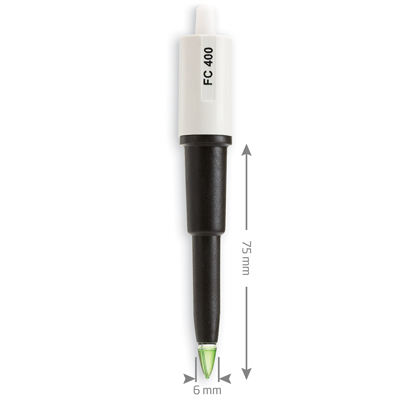
The FC400B is a PVDF body, double junction pH electrode that has a BNC connector. The FC400B electrode features an open junction design with viscolene gel electrolyte, a sensing bulb made of low temperature glass, and a conical tip shape.
This design consideration is ideal for pH measurements in products such as meats and semi-frozen food products. The recommended operating temperature range is from 0 to 50°C.

Low Temperature Glass

PVDF Body

Open Junction
The FC400B is a PVDF body, double junction pH electrode that has a BNC connector. The FC400B electrode features an open junction design with viscolene gel electrolyte, a sensing bulb made of low temperature glass, and a conical tip shape.
This design consideration is ideal for pH measurements in products such as meats and semi-frozen food products. The recommended operating temperature range is from 0 to 50°C.
Low Temperature Glass
PVDF Body
Open Junction
Single Junction Versus Double Junction pH Electrodes
Conventional electrodes are normally single junction. As depicted by the figure above, these electrodes have only a single junction between the internal reference wire and the external solution. Under adverse conditions, such as high pressure, high temperature, highly acidic or alkaline solutions, the positive flow of the electrolyte through the junction is often reversed resulting in the ingress of sample solution into the reference compartment. If this is left unchecked, the reference electrode can become contaminated, leading to complete electrode failure. Another potential problem with single junction electrodes is the clogging of the junction due to silver chloride (AgCl) precipitation. Silver can be easily precipitate in samples that contain Tris buffer or heavy metals. When the electrolyte solution makes contact with the sample, some AgCl will precipitate on the external face of the junction. The result is drifty readings obtained from the sensor.
Hanna’s double junction system, as the name implies, has two junctions, only one of which is in contact with the sample as shown in the figure. Under adverse conditions, the same tendency of sample ingress is evident. However, as the reference electrode system is separated physically from the intermediate electrolyte area, the contamination of the electrode is minimized. The likelihood of clogging of the junction is also reduced with a double junction electrode since the outer reference cell uses a fill solution that is “silver-free”. Since there is no silver present, there is no precipitate forming to clog the junction.
| Measurement Range | pH: 0 to 12 |
|---|---|
| Reference Cell Type | double, Ag/AgCl |
| Junction Type/Flow Rate | open |
| Type of Electrolyte | viscolene |
| Body Material | PVDF |
| Tip / Shape | conic (6 x 10 mm) |
| Matching Pin | no |
| Max. Pressure | 0.1 bar |
| Temperature Operating Range | 0 to 50°C (32 to 122°F) – LT |
| Body Length/Overall Length | 75 mm / 111.5 mm |
| Temperature Sensor | no |
| Outer Diameter | 6 mm |
| Cable | coaxial; 1 m (3.3’) |
| Connector Type | BNC |
| Amplifier | no |
| Recommended Use | meat |