![[:lt]HI779-11 - Standartinis sertifikuotas Pool Line pH rinkinys[:en]HI779-11 - Pool Line pH Certified Standard Kit[:]](https://hannainst.lt/wp-content/uploads/2024/05/HI779-11-4437x4437-04a1edb9-85f3-40a4-aa97-e98e53520385.png)
![[:lt]HI3827 - Katilo testų rinkinys; šarmingumas, chloridai, kietumas, pH, fosfatai ir sulfitai[:en]HI3827 - Boiler test kit; alkalinity, chloride, hardness, pH, phosphate and sulfite[:]](https://hannainst.lt/wp-content/uploads/2024/05/HI3827-3031x3032-5107058b-1d85-4844-84a3-0dad2b49be8d.png)

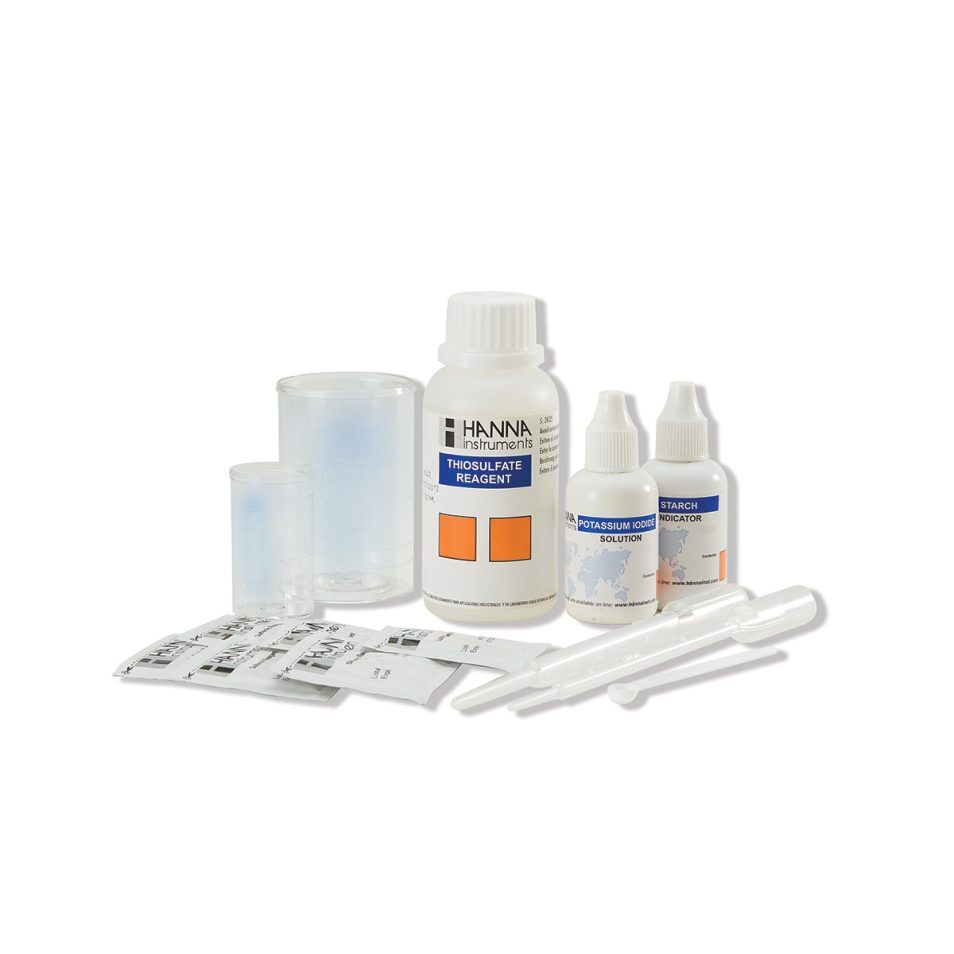
HI38022 is a kit for the analysis of total chlorine in the range of 0.0 to 4.0 mg/L (ppm) or 0.0 to 20.0 mg/L (ppm). The HI38022 is supplied with all reagents and accessories required to perform the analysis.
Features
- Complete set
- All necessary accessories are included in the kit, such as beakers, reagent bottles and sachets, plastic pipettes, spoon.
- High resolution
- Resolution of 0.2 mg/L for measurements between 0.0 and 4.0 mg/L.
- Resolution of 1.0 mg/L for measurements between 0.0 and 20.0 mg/L.
- Spare reagents available
- There is no need to buy a new kit when reagents run out. You can order the replacement reagent set HI38022-100. This reagent set is supplied with 1 dropper bottle (30 mL) of potassium iodide, 100 sachets of sulphamic reagent, 1 dropper bottle (25 mL) of starch indicator and 1 bottle (100 mL) of thiosulphate reagent.
Importance of use
Chlorination of water supplies and polluted water is mainly used to remove or deactivate disease-carrying microorganisms. Chlorine is also used to improve the quality of drinking water, as it reacts with ammonia, iron, manganese, sulphides and certain organic substances. However, high amounts of chlorine will produce unfavourable effects such as the formation of compounds that are potentially carcinogenic (e.g. chloroform) or dangerous to aquatic organisms (e.g. chloramines). It is important to control the amount of chlorine added in order to meet the need for disinfection while also minimising unfavourable effects.