![[:lt]HI3850 - Askorbo rūgšties testų rinkinys[:en]HI3850 - Ascorbic Acid Test Kit[:]](https://hannainst.lt/wp-content/uploads/2024/05/ascorbic-acid-range-10-200-mg-l.jpg)
![[:lt]HI3818-100 - Anglies dioksido reagentų rinkinys, 110 testų[:en]HI3818-100 - Carbon dioxide reagent kit for 110 tests[:]](https://hannainst.lt/wp-content/uploads/2024/05/HI3818-100-3463x3463-3bfc0b0e-22b8-4904-8efa-443b3761d869.png)

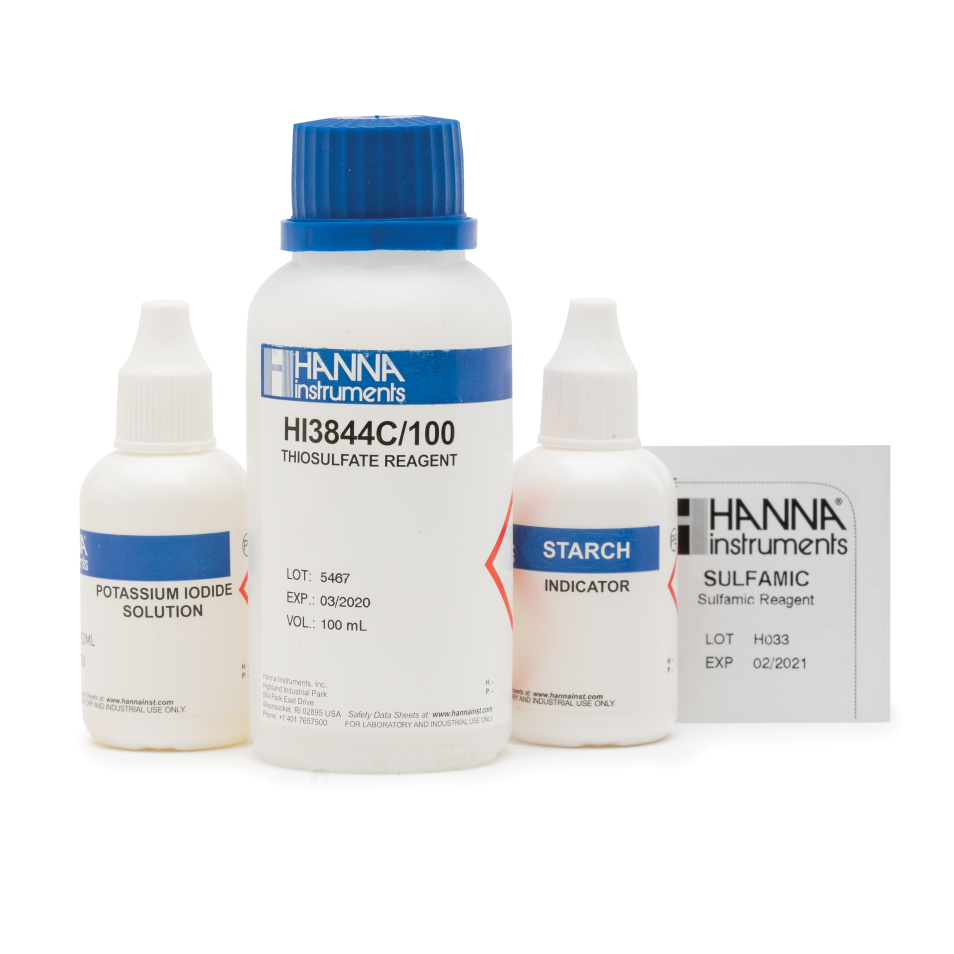
Total chlorine reagent kit for 100 tests (extended range, iodometric method)
During testing, when colour change is achieved, under careful conditions – usually using a burette – the reagent is added, drop by drop, until the solution turns to the colour required. The user will then count how many drops of reagent were used to achieve complete colour change. The number of drops used will determine the chemical concentration and results can be found in the manual included.
Significance and use
The chlorination of water supplies and polluted waters is used mainly to destroy or deactivate disease-producing microorganisms. It also serves to improve the quality of drinking waters, as chlorine reacts with ammonia, iron, manganese, sulfide and some organic substances. Nevertheless high amounts of chlorine will produce adverse effects, like formation of compounds which are potentially carcinogenic (e.g. chloroform) or harmful to aquatic life (e.g. chloramines). Thus it is essential to control that the proper amount of chlorine has been added in order to fulfill the primary purpose of disinfecting and to minimize any adverse effect.